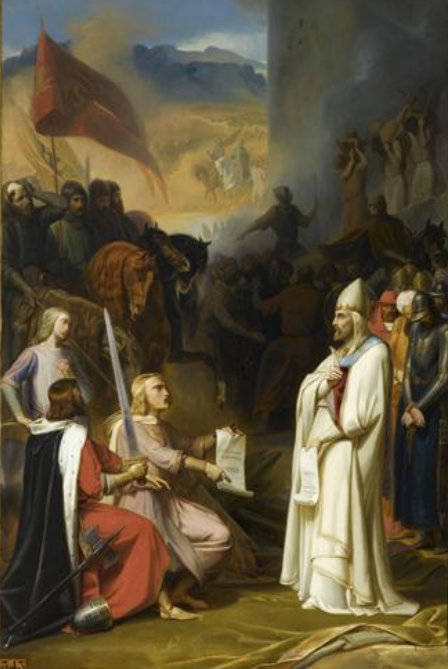
By 1053, the Normans had been carving out power in southern Italy for some forty years. Arriving as mercenaries in the service of Lombard and Byzantine princes, they had gradually seized counties, towns, and entire territories. Humphrey of Hauteville (Onfroi), Count of Apulia, and his brothers Robert Guiscard and Richard of Aversa embodied this boundless ambition.
Faced with this expansion, Pope Leo IX decided to act. A German by birth and cousin of Emperor Henry III, he assembled a diverse coalition: hardened Swabian infantry, known for their tenacity in battle, and Italian cavalry recruited from the Lombard regions of the south, from Campania to the Abruzzi. Confident in this army, he marched toward Apulia to crush the Norman invaders once and for all.
On June 18, 1053, the two armies met near Civitate, in the Apulian plain. The papal army held a position on higher ground. The Swabians, elite infantry, formed the left wing. The Italian cavalry held the right. Opposite them, the Norman knights deployed in three groups, mounted and intent on attack.
At the first clash, the Lombard cavalry fled or was scattered, leaving the Swabians isolated. They resisted with remarkable bravery, but the Normans, unwilling to relent, were at times forced to dismount to overcome this infantry that refused to break. After prolonged fighting, the Swabian foot soldiers were finally overwhelmed and massacred. Almost none survived.
Pope Leo IX, who had taken refuge in Civitate, was captured by the Normans. They held him prisoner with courtesy, but he did not survive the humiliation. He died in Rome in April 1054, a few months after his release, broken by defeat.
Civitate marked the end of any hope of halting Norman power. Within a few decades, the Normans would dominate all of southern Italy and Sicily, founding a kingdom that would last two centuries.